



English
Hindi
English
Hindi
Hello friends
1) How a Level 1 shooter thinks.
welcome to a brand new video. In the last two videos The Curious Case of the missing tens and how to shoot rows of tens, we saw how a level one shooter has got very narrow concentric thinking pattern, which shows that his mind is completely focused on each and every step of the short execution, right from the time he lifts the pistol, from the firing platform till he brings his sights into the aiming area and it stays 100 mentally focused.
There is no other thought in his mind except for watching his sights, which are sharp aligned and completely focused when they come in the aiming area. And he is concentrating 100 % on the trigger execution.
And in between two shots, he is continuously visualizing what he is going to do when the sights come into the aiming area. There is no wonder that if you see his focus it is very narrow as compared to the level 6 shooter whose thoughts are so scattered that even when he’s sitting on the firing point during a practice session when he is relaxing when he’s sitting down between two series his thoughts are outside the shooting range as we had discussed in the previous video.
welcome to a brand new video. In the last two videos The Curious Case of the missing tens and how to shoot rows of tens, we saw how a level one shooter has got very narrow concentric thinking pattern, which shows that his mind is completely focused on each and every step of the short execution, right from the time he lifts the pistol, from the firing platform till he brings his sights into the aiming area and it stays 100 mentally focused.
There is no other thought in his mind except for watching his sights, which are sharp aligned and completely focused when they come in the aiming area. And he is concentrating 100 % on the trigger execution.
And in between two shots, he is continuously visualizing what he is going to do when the sights come into the aiming area. There is no wonder that if you see his focus it is very narrow as compared to the level 6 shooter whose thoughts are so scattered that even when he’s sitting on the firing point during a practice session when he is relaxing when he’s sitting down between two series his thoughts are outside the shooting range as we had discussed in the previous video.
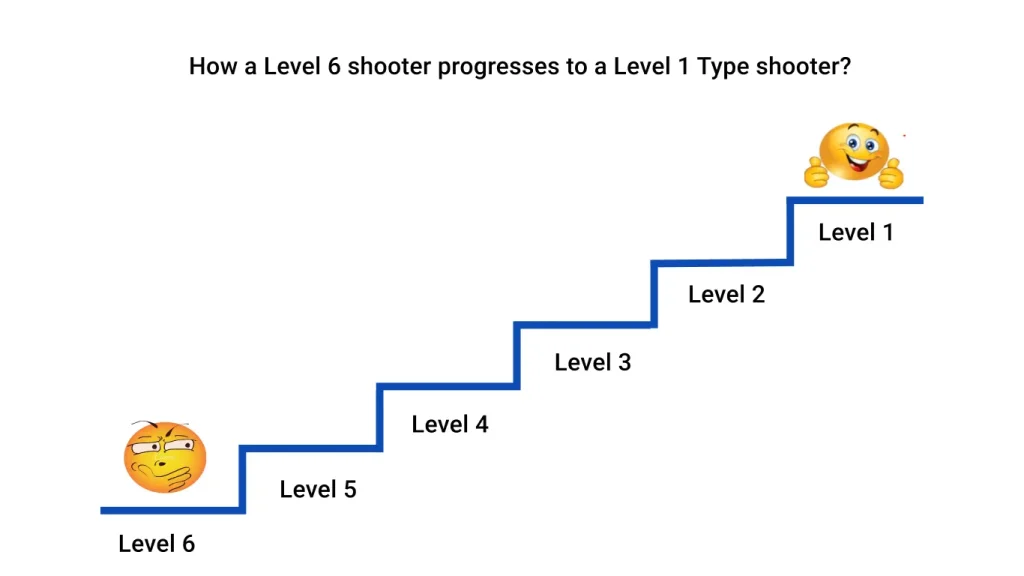
2) How a level 6 shooter progresses to Level 5,4,3 Shooter.
Today we are going to discuss the level 5, the level 4 and level 3 shooter. Now, as his desire of the level 6 shooter, if his desire is to improve, his performance his score, then gradually, very naturally he starts focusing his thoughts during his practice session, right from the time he comes on the firing point till he completes his practice session or his match and leaves the firing point, his mental focus improves.
He begins to start thinking more and more about what he is going to do when his sights come into the aiming area and as his mental focus improves and as he starts getting rid of unwanted thoughts, which are not related to his shooting or not related to the execution of the next shot, as he keeps on reducing it, his mental focus starts improving for each and every series and that is why he now starts scoring around 90 to 91. this is a level 5 shooter.
Once again as his desire to improve his shooting increases, he realizes that he should concentrate more on what he is doing right from the time he begins his practice session till he completes his practice session and therefore you see less number of unwanted thoughts coming into his mind and therefore his mental focus starts improving and he starts shooting above 91 94 95 96Which means that when you come to the firing point, your external thoughts which have got nothing to do with your shot execution should be eliminated and this requires a lot of mental discipline and requires systematic training.
Shooters who cross 90, go to 93 94 95 96 97 they learn to keep out all the thoughts which are not related to the shot execution.
Today we are going to discuss the level 5, the level 4 and level 3 shooter. Now, as his desire of the level 6 shooter, if his desire is to improve, his performance his score, then gradually, very naturally he starts focusing his thoughts during his practice session, right from the time he comes on the firing point till he completes his practice session or his match and leaves the firing point, his mental focus improves.
He begins to start thinking more and more about what he is going to do when his sights come into the aiming area and as his mental focus improves and as he starts getting rid of unwanted thoughts, which are not related to his shooting or not related to the execution of the next shot, as he keeps on reducing it, his mental focus starts improving for each and every series and that is why he now starts scoring around 90 to 91. this is a level 5 shooter.
Once again as his desire to improve his shooting increases, he realizes that he should concentrate more on what he is doing right from the time he begins his practice session till he completes his practice session and therefore you see less number of unwanted thoughts coming into his mind and therefore his mental focus starts improving and he starts shooting above 91 94 95 96Which means that when you come to the firing point, your external thoughts which have got nothing to do with your shot execution should be eliminated and this requires a lot of mental discipline and requires systematic training.
Shooters who cross 90, go to 93 94 95 96 97 they learn to keep out all the thoughts which are not related to the shot execution.
3) What prevents a Level 3,2 shooter from shooting 100/100 series.
For the level 3 and 2 shooter who’s shooting around 97 out of 100, 99 out of 100, his level of focus, his level of concentration is far superior to level six, level five and level four shooter.
But even now the only reason why he cannot shoot 100 out of 100 is because his mind is on the score, specifically on the result of the last shot and the effect of that shot will have on the final score. And because he’s thinking of that, he cannot shoot 100 out of 100, so he shoots 97, 98, 99 that’s it if you wish to shoot 100 out of 100 series you have to mentally discipline yourself to not be affected by the score.
And as I keep telling shooters, stop scoring. Instead concentrate on enjoying the execution of each shot, concentrate on each and every step of the shot execution, right from the time you lift the pistol, from the firing platform until the sights come into the aiming area, until the shot is executed and you are executing correct follow-through.
For the level 3 and 2 shooter who’s shooting around 97 out of 100, 99 out of 100, his level of focus, his level of concentration is far superior to level six, level five and level four shooter.
But even now the only reason why he cannot shoot 100 out of 100 is because his mind is on the score, specifically on the result of the last shot and the effect of that shot will have on the final score. And because he’s thinking of that, he cannot shoot 100 out of 100, so he shoots 97, 98, 99 that’s it if you wish to shoot 100 out of 100 series you have to mentally discipline yourself to not be affected by the score.
And as I keep telling shooters, stop scoring. Instead concentrate on enjoying the execution of each shot, concentrate on each and every step of the shot execution, right from the time you lift the pistol, from the firing platform until the sights come into the aiming area, until the shot is executed and you are executing correct follow-through.
4) How to shoot 100/100 series.
You have to 100 % focus on each and every step. If you manage to do that then you will shoot 100 out of 100 series regularly.
The 97, 98, 99 card shooter, the level 3, level 2 Shooters, the only reason that they don’t shoot 100 out of 100 is because the mind is on the last shot and so they get mentally disturbed.
In the next video, we will be discussing the relationship between how your thinking disturbs your mood, (which we have already discussed), How your thinking affects your mood, your mood affects your energy level, your energy level affects your concentration level and it affects your performance.
foreign Till then, please like this video, subscribe to my video and do share this video. If you have any questions, any doubts, please contact me on my WhatsApp number, email ID and cell number. Till then have a good day and happy shooting.
You have to 100 % focus on each and every step. If you manage to do that then you will shoot 100 out of 100 series regularly.
The 97, 98, 99 card shooter, the level 3, level 2 Shooters, the only reason that they don’t shoot 100 out of 100 is because the mind is on the last shot and so they get mentally disturbed.
In the next video, we will be discussing the relationship between how your thinking disturbs your mood, (which we have already discussed), How your thinking affects your mood, your mood affects your energy level, your energy level affects your concentration level and it affects your performance.
foreign Till then, please like this video, subscribe to my video and do share this video. If you have any questions, any doubts, please contact me on my WhatsApp number, email ID and cell number. Till then have a good day and happy shooting.