


Hello friends,
Success in ISSF 10m Air Pistol is not based only on technique. It is also governed by simple principles of physics and biomechanics.
When a shooter extends the pistol toward the target, the body and the pistol together form a balance system similar to a lever or pendulum. Even small shifts in posture can cause noticeable movement at the muzzle.
Understanding the physical foundations of stability helps shooters build positions that are naturally steady rather than forced through muscle effort.
Three key factors determine shooting stability.
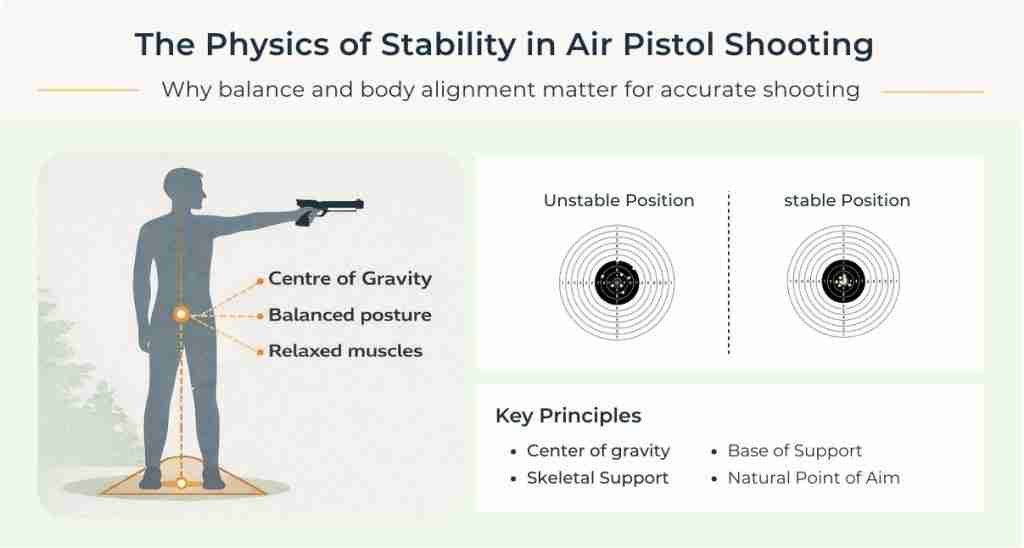
Centre of Gravity
The human body remains stable when its centre of gravity stays balanced over its base of support.
If a shooter leans excessively forward or backward, muscles must work continuously to prevent the body from becoming unbalanced. This muscular effort introduces tension and tremors.
Elite shooters maintain a posture where the body weight rests comfortably over the feet. The spine remains upright, allowing the skeletal structure to carry most of the load.
When the body is balanced in this way, the muscles can remain relaxed, and stability improves significantly.
Base of Support
The feet create the foundation of the entire shooting position.
A well-balanced stance allows the shooter to remain steady for long periods without unnecessary strain.
Most air pistol shooters adopt a stance slightly wider than shoulder width, with the body turned sideways or angled toward the target.
This position provides both balance and freedom of movement.
However, a stance that is too wide can introduce tension in the legs and hips. The key is to find a position that feels stable but still relaxed.
Skeletal Support vs Muscle Effort
One of the most important principles of elite shooting technique is the use of skeletal support instead of muscular strength.
If muscles are used to hold the pistol in place, fatigue will quickly set in. Tremors increase, and stability decreases.
Elite shooters align their bodies so that the bones support most of the weight of the pistol and arm.
In this position, muscles act mainly as stabilizers rather than as primary supports. This approach allows shooters to maintain stability throughout long competitions.
The Importance of Natural Point of Aim
Another critical concept related to stability is the Natural Point of Aim (NPA). Natural Point of Aim refers to the direction the pistol naturally points when the shooter is relaxed.
If the shooter closes their eyes and then reopens them, the sights should remain aligned with the target. If they drift away, it means the body is misaligned.
Many shooters attempt to correct this by forcing the pistol toward the target with arm muscles. This creates tension and reduces stability.
The correct solution is to adjust the feet until the pistol naturally points at the centre of the target.
When Natural Point of Aim is correct, the pistol returns to the target effortlessly after each shot, creating a stable and repeatable shooting position.