


Hello friends,
Every shot has a beginning long before the pistol is raised.
– Long before the sights appear in the aiming area.
– Long before the trigger begins its journey.
That beginning is Priming.
– Most shooters never see it.
– Fewer still respect it.
Yet it is here in silence
that the fate of the shot is decided.
What Is Priming?
Priming is the deliberate mental and emotional preparation done before the shot begins,
designed to place the shooter in an automatic, non-threatened state
so the shot can be executed without conscious control.
It is not motivation.
It is not positive thinking.
It is not imagination.
Priming is state preparation.
It aligns the mind, breath, and intent
so the body can perform what it already knows—without interference.
When Does Priming Begin?
Priming begins just before the pistol is raised for the next shot.
Not when the sights settle.
Not when the trigger is touched.
It begins earlier—when the shooter pauses between shots and makes a quiet internal decision:
“How will I enter the next shot?”
This phase typically lasts 20 to 40 seconds.
To the untrained eye, nothing appears to be happening.
In reality, everything is happening.
Priming belongs entirely to the Pre-Shot Phase.
It sits before:
• Lift
• Aim
• Trigger engagement
Which means it controls everything that follows.
If priming is unstable, the shooter enters the shot already negotiating with fear.
If priming is correct, the shooter enters the shot already resolved.
The Purpose of Priming
Priming prepares the mind to follow direction instead of demanding control.
It gently sets the internal conditions required to:
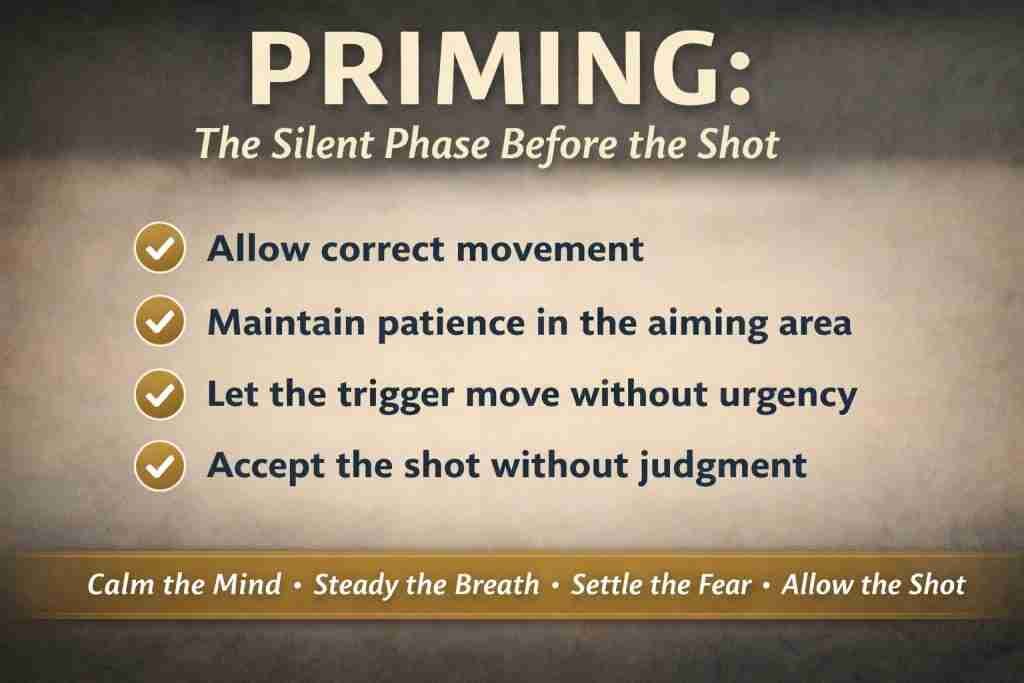
• Allow correct movement
• Maintain patience in the aiming area
• Let the trigger move without urgency
• Accept the shot without judgment
In simple terms:
Priming prepares the shooter to allow a ten, not chase it.
How Priming Is Executed
Priming is usually anchored using a CUE—a visual reference that signals the nervous system it is time to enter shooting mode.
The cue is not symbolic.
It is functional.
It tells the brain:
“This is familiar. This is safe. This is routine.”
Breathing is then activated deliberately—not for relaxation, but for synchronisation.
Breath and trigger are linked.
This is often reinforced by dry firing on the firing point, while maintaining soft visual contact with the cue card.
The body is not being trained here.
The mind is.
Priming and the Mantra
Along with priming, a Mantra may be used—as discussed in the Yoga of Shooting Guide or Yoga of Shooting Course.
The mantra is not meant to overpower thought.
It is meant to occupy attention.
A mind occupied with rhythm cannot wander into fear.
What Happens When Priming Is Done Correctly
When priming is correct:
• The lift feels lighter
• The sights feel less threatening
• The trigger moves without negotiation
The shot surprises the shooter—not because of carelessness, but because the mind has stepped aside.
These surprise shots are not accidents.
They are the natural outcome of correct priming.
And these are the shots that land in the ten.
Priming Must Become a Habit
Priming is not used occasionally.
It is used between shots.
Until it stops feeling like a process.
Until it becomes second nature.
Only then does performance stabilise under pressure.
There are no shortcuts here.
The Real Enemy Priming Eliminates
Priming protects the shooter from the most dangerous opponent in shooting:
anticipatory fear.
Fear of:
• Shooting a bad shot
• Whether the sights will align
• Whether they will remain steady and sharply focused
• Whether the trigger will execute within the correct timing—usually 6 to 9 seconds
These fears do not appear at the trigger.
They are born before the pistol is lifted.
Priming shuts the door on them—quietly, efficiently, without drama.
The Truth Most Shooters Miss
If you do not prime deliberately, your mind will prime itself.
And it will usually prime:
• Doubt
• Urgency
• Outcome obsession
Once that happens, no amount of technical perfection can rescue the shot.
Final Word
Priming is not an accessory to shooting.
It is the gateway to execution.
Between intention and action.
Between effort and trust.
Between forcing the shot—and allowing the ten.
Ignore it, and pressure will always win.
Master it, and the shot finally becomes what it was meant to be:inevitable.