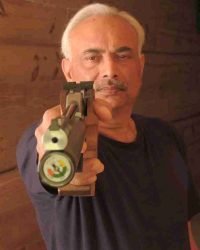



Hello friends,
Let me begin this video with a funny experience when I started shooting many years ago.
Let me begin this video with a funny experience when I started shooting many years ago.
English
Hindi
English
Hindi
During those days, a very famous personality, Mr. Bam, used to be an exponent of mental training. All of us attended his class and some of the shooters were so impressed by his mental skill training that they used to come to the shooting range for practice. They would sit on the shooting range and go into the Lotus position in a meditative trance for half an hour to 45 minutes, then shoot a few shots. That was all the training they used to do.
Now mental skills are correct, but you must also train physically along with cognitive skills. I understand shooting is all about mental skills, which is 90 percent, and 10 percent is your physical skills and technical skills. I know that, but there has to be a perfect balance.
You cannot just concentrate on mental skills and expect to shoot 580 plus, nor can you just focus on mastering your Technique and just keep on shooting shots after shots after shots and neglect mental skills.
There has to be a balance in the physical aspect, even though it is 10 percent. You have to develop your muscle groups, the specific muscle groups required for shooting 100 to 300 shots per day or even more, but that depends on how much time you have and how many images you wish to shoot. Accordingly, your physical fitness has to be there to prevent injuries and to shoot correctly. Now in this ten also the physical part of shooting There is five percent which is called the technical aspect, and this technical aspect is elementary.
You must know how to shoot a 10. That is your Technique of how to shoot a 10; it differs from shooter to shooter, there are three main steps of shooting a ten, and you have to train systematically and learn these three steps. Now the first step is mastering the aiming process and making it automatic.
The second step is mastering your trigger operation and making your trigger operation automatically
The third important thing is to keep your mental focus, attention, and concentration on the trigger operation follow-through, which is that your trigger should move smoothly continuously before, during, and after the shot is fired. Your mind has to be focused 100 on the trigger operation follow-through.
So these three steps you have to master to learn how to shoot not only one ten but rows of tens. To shoot tens consistently. In the following videos, I will focus one video on each step. One video will only focus on the aiming process and how to master it; the second will focus only on executing the trigger operation and making it automatic. The third video will be on mental focus, follow through, and how you can Master it. Please like this video, subscribe to my channel, and share this video with as many people as possible. If you have any questions, my contact details are at the end of this video. Please do not hesitate to contact me. Thank you, and have a perfect day.
You cannot just concentrate on mental skills and expect to shoot 580 plus, nor can you just focus on mastering your Technique and just keep on shooting shots after shots after shots and neglect mental skills.
There has to be a balance in the physical aspect, even though it is 10 percent. You have to develop your muscle groups, the specific muscle groups required for shooting 100 to 300 shots per day or even more, but that depends on how much time you have and how many images you wish to shoot. Accordingly, your physical fitness has to be there to prevent injuries and to shoot correctly. Now in this ten also the physical part of shooting There is five percent which is called the technical aspect, and this technical aspect is elementary.
You must know how to shoot a 10. That is your Technique of how to shoot a 10; it differs from shooter to shooter, there are three main steps of shooting a ten, and you have to train systematically and learn these three steps. Now the first step is mastering the aiming process and making it automatic.
The second step is mastering your trigger operation and making your trigger operation automatically
The third important thing is to keep your mental focus, attention, and concentration on the trigger operation follow-through, which is that your trigger should move smoothly continuously before, during, and after the shot is fired. Your mind has to be focused 100 on the trigger operation follow-through.
So these three steps you have to master to learn how to shoot not only one ten but rows of tens. To shoot tens consistently. In the following videos, I will focus one video on each step. One video will only focus on the aiming process and how to master it; the second will focus only on executing the trigger operation and making it automatic. The third video will be on mental focus, follow through, and how you can Master it. Please like this video, subscribe to my channel, and share this video with as many people as possible. If you have any questions, my contact details are at the end of this video. Please do not hesitate to contact me. Thank you, and have a perfect day.