



Hello friends,
Sorry for being Blunt!
Being sweet and diplomatically correct, or mollycoddling, will not win you a medal.
Compare an Olympic 10M air pistol shooter: from the moment the pistol is lifted to the follow-through, they are so smooth, calm, and almost mechanical. No emotions and no wasted unnecessary movements — just smooth and clocklike.
It feels like they’re doing nothing special, nothing different — yet the scoreboard is different from yours.
The secret lies in the simple fact that their shooting routine, or each shot cycle, is so polished that they leak fewer points.
The beauty of it all
The beauty of it all is that these leaking points can be plugged.
With my 30+ years of experience, I will help you identify them, and if you plug them in, your performance and scores will improve dramatically.
So, let’s dive in and cut to the chase, shall we?
Let’s break down the Shot Cycle to see what genuinely works, what doesn’t, and how you and others silently sabotage your scores.
But before we actually dive in, allow me to explain two concepts, the first is:
1. The ‘Route’.
2. The ‘Aiming Process’.
These two concepts will be used to amplify the points that differ between your shot cycle and that of an Olympic Shooter.
What is the Route?
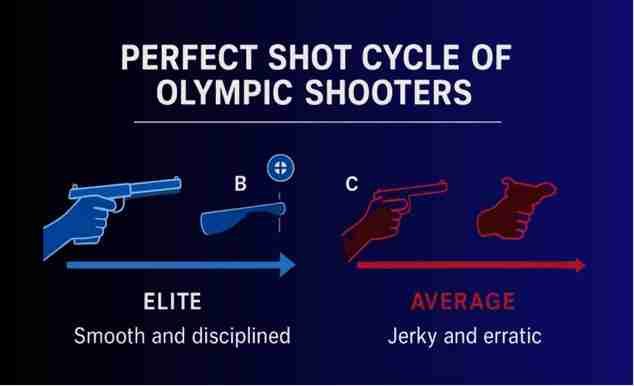
a. The shooter lifts his pistol from the firing platform, this point is called as ‘A’.
b. His sights trace a path upwards in a straight line to a point ‘B’ above the target, where the shooter takes a few seconds to align his sights before moving downwards into the aiming area, which we shall call Point ‘C’.
c. The sights remain in ‘C’, from the time the trigger operation commences till the shot is executed and follow-through is completed, this is ‘Ft’.
So, the sights of the pistol trace a path from A → B → C → Ft.
This path is called the ‘Route’.
What is the Aiming Process?
a. Aligned and steady
b. In sharp focus
c. Reduced arc of movement
And all the above points should happen automatically.
OK, now we are free to dive in;1. What are you thinking before each Record Shot – The Invisible Start Line
The majority of shooters, almost 99%, THINK that the shot cycle begins when they pick up the gun. Wrong!
It begins a few minutes or a few seconds before you lift the pistol to shoot the first record shot.
What elite shooters do:
a. They are emotionally cool, calm, composed, and confident.
b. They are confident because they know that the moment the sights come into the aiming area, the sights will be aligned and in sharp focus with a reduced arc of movement — which is the Aiming Process — and they know this will happen automatically.
c. Because the Aiming Process is automatic, they know that their trigger operation will also be automatic the moment the sights come into the aiming area.
d. They have a mental script or preset steps that they follow before each shot.
e. By rehearsing these steps, they prime their subconscious mind to run through the process or pre-shot routine by being emotionally stable.
Where average shooters leak points:
a. Average shooters spend mental energy fighting emotional turmoil from the previous shot.
b. They are over-anxious to shoot a 10 instead of coolly following the routine steps.
c. They are afraid of shooting a bad shot.
d. They have not mastered the Aiming Process or the trigger operation; naturally, they lack confidence when the sights enter the aiming area.
e. This allows stress to interfere with the first 2 seconds of the lift from A to B.
Truth: If the results of the previous shot hijack your mind, and if you lack confidence in your technique, then the shot is already compromised.
2. Lifting the Pistol (The Lift) – The First Technical Landmine
You can spot the difference between a trained shooter and an average wannabe great shooter in the first 3 seconds of the lift from A to B.
Elite shooters:
a. Lift only as high as necessary above the target, which is Point B.
b. Their lift is consistently to the same Point B above the target.
c. The lift is smooth, calm, and measured, and this happens for each and every shot.
d. Their body language is relaxed, especially the muscles of the shoulders.
Point Leak Warning:
a. Unnecessary overlifting high above the target — Point B becomes too high. This increases muscle load, creating tension and tremors in the shooting arm.
b. Under-lifting quickly, taking the gun abruptly above the target (snatching movement), again causing muscular tension and tremors.
c. Both actions lead to tremors in the muscles.
The lift is the opening pitch. If it is scrappy or rough, you silently pay for it in the next few seconds.
3. Aiming: The “Zen Phase – Calm, composed and relaxed.”
Aiming is not about staring harder at the sights. It’s about settling.
What elites do from B to C:
a. Their Aiming Process is AUTOMATIC. They don’t chase the perfect sight picture because they KNOW it will be perfect.
b. They KNOW that their arc of movement will be reduced.
c. They KNOW their sights will be in sharp focus, so they don’t strain their eyes unnecessarily.
Where shooters lose points:
a. Wasting time over-aiming, trying to force their sights to be steady, aligned, sharp, and with reduced arc of movement.
b. Conscious micro-corrections, which aggravate the sights.
c. Intense staring to keep the focus sharp, leading to fatigue and eye blurring.
If your brain starts screaming, “HOLD STILL!” you’re already dead in the waters.
4. Trigger Operation: Star Performer or Paid Assassin.
The “star performer” — the one element that contributes the most to success.
Let’s face reality! 90% of bad shots are trigger-related, not aiming-related.
Elite behaviour:
a. The second pull of the trigger starts automatically as soon as the sights settle into the aiming area.
b. The trigger operates smoothly and continuously before, during, and after the shot is fired.
c. The shot breaks within the comfort zone window — usually 6–9 seconds.
Non-elite behaviour:
a. “Holding too long for the sights to be aligned, in focus, and with reduced arc of movement, thereby delaying the trigger!”
b. Fear of a bad shot prevents pulling the trigger.
c. Delay leads to running out of breath, causing cancellation.
d. Too many cancellations create time pressure for the remaining shots.
Trigger timing is the Key to becoming an Elite shooter.
5. Follow-Through: The Most Neglected Phase
Most shooters drop follow-through like a hot potato. Elite shooters treat it like sacred ground.
Elite actions:
a. Maintain everything you were doing before the shot (balance, breathing, steady sights, sharp focus, reduced arc of movement, smooth continuous trigger operation), continue it during the shot, and after the shot is fired for 1–2 seconds post-shot.
b. Keep body and face still.
c. Observe the recoil and movement pattern calmly.
d. Log the feedback internally without emotional commentary.
Common errors:
a. Dropping the arm immediately.
b. Looking at the monitor too early.
c. Letting emotions declare victory or defeat prematurely.
A clean follow-through is the difference between learning and repeating mistakes.
6. Post-Shot Reset: The Forgotten Hero
The moment after the shot determines the next shot’s fate.
Olympic shooters:
a. Reset their breathing; some use pranayama yogic breathing techniques like Anulom Vilom to bring the heart rate back to normal.
b. Focus on the next sequence of steps to be followed for the next shot, helping them disconnect emotionally from the result of the previous shot.
Regular shooters:
a. Get emotional by celebrating a 10.
b. Complain or think excessively about what went wrong on a bad shot, reinforcing errors and increasing the chance of repeating them.
c. If the previous shot was bad, they put pressure on themselves to shoot a 10 or multiple 10s to “compensate.”
This is where the match is quietly won or lost.
In Summary: What Olympic Elite Shooters Do Differently
a. They don’t try harder — they execute cleaner.
b. They don’t chase 10s — they run their shot cycle with ruthless consistency.
c. They don’t depend on motivation — they depend on process automation (subconscious programming).
d. They don’t gamble each shot — they replicate a repeatable system.
Your shot cycle isn’t just a routine.
It’s your performance engine.
When you tighten it, your results don’t just “improve”… they transform.